
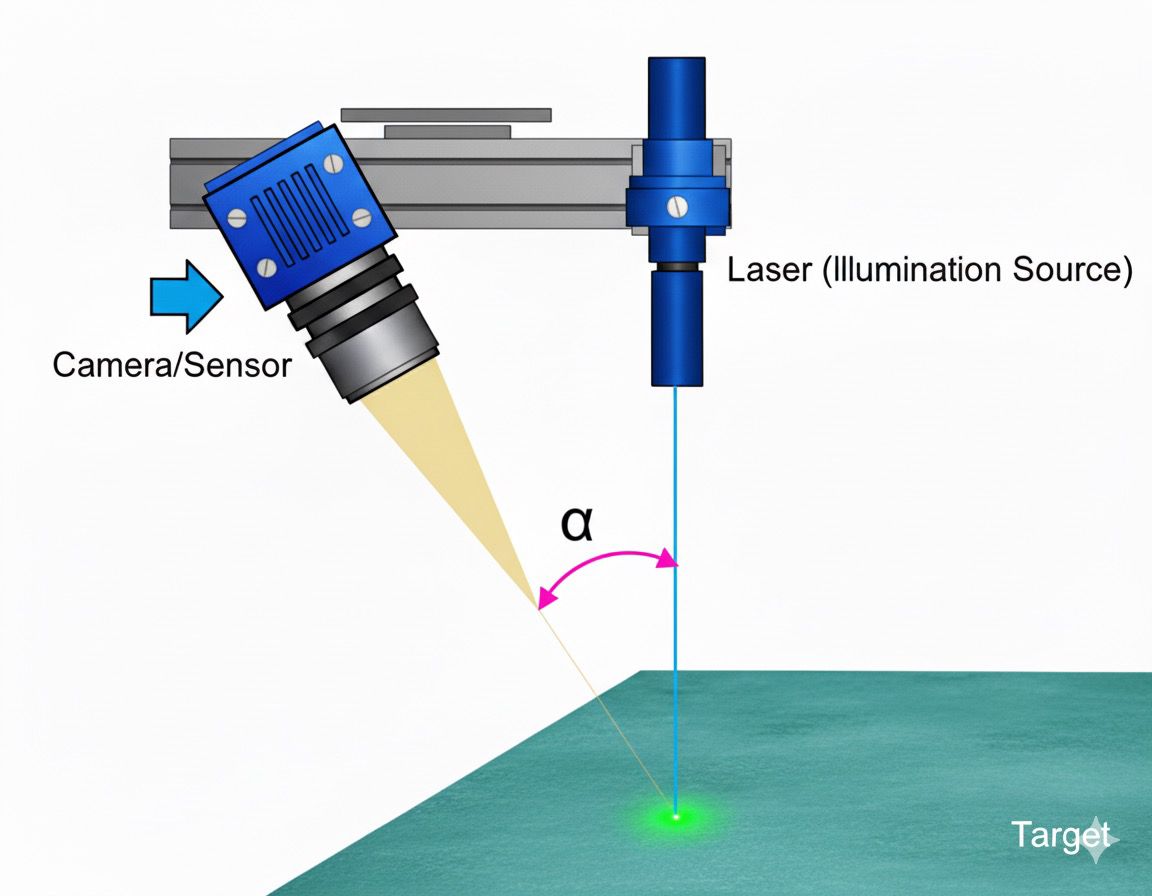

Measurement uncertainty describes the range within which a measured value can be expected under real operating conditions. In inline measurement technology, it is not merely a property of the sensor itself, but the result of the entire measurement system within the production process (sensors, mechanics, motion/handling, environmental conditions, and data evaluation).
Triangulation sensor
Precision describes the spread of repeated measurements (How close are the measured values to each other?).
Accuracy describes the deviation from the “true” value (How close is the measured value to the target or nominal value?).
For stable inline decisions, both parameters must always be considered within the context of the production process.
In laboratory settings, measurement conditions are often stabilized (temperature, vibration, positioning, cycle timing). In production lines, however, additional influences overlay the theoretical sensor performance—for example positioning variations caused by handling systems, variations in parts and surfaces, or drift due to temperature changes.
Even if an optical measurement method can measure in the micrometer range, the overall uncertainty in the production line may be dominated by the handling system. QuellTech, for example, describes cases where a robot achieves positioning accuracy only in the range of hundreds of micrometers, while the sensor itself is significantly more precise. In such situations, it is not the nominal sensor resolution that determines the result, but the measurement strategy (e.g., referencing, feature selection, suitable evaluation and filtering logic) that determines whether process-capable results can be achieved.
Define the measurement task in relation to the process (What quality decision needs to be made?).
Identify dominant influencing factors (handling, temperature, vibration, surface properties, cycle time).
Design the measurement strategy (references, measurement windows, averaging/filtering, feature extraction).
Validate under real production conditions (not only in the laboratory).
Monitor during operation (drift and stability checks, threshold values for system states).
For inline applications, QuellTech focuses on robust, process-relevant feature extraction and measurement strategies that account for real-world disturbances—ensuring that precision and accuracy can be effectively used for stable process evaluation.
Precision/accuracy and the influence of handling in practice:
Fundamentals of industrial image processing and laser technology
Laser triangulation sensors for robust inline applications:
Laser triangulation sensor
We are happy to help you with that!
Stefan Ringwald
Technical Contact
If you have any questions about Optical Inline Measurement or would like a consultation from QuellTech on this subject, we will be happy to help.
We would like to help you to precisely evaluate your specific measurement task. Through an initial free test measurement of your application, we can give you an early assessment of the feasibility.
There is always potential for improvement, we will help you with that. Contact us for more information or to make an appointment for a consultation.
Would you like to assess the feasibility of your measurement task as early as possible? Take advantage of our free initial sample measurement.
By submitting the contact form, you agree that your data will be used to process your request (further information and instructions on withdrawal can be found in the privacy policy).
Your technically competent contact, Stefan Ringwald, will be happy to help you.
Our aim is to fully understand your specific technical requirements for your current measurement task.
Thanks to many years of experience with complex tasks in the field of 3D laser measurement, you will receive well-founded solution proposals from us.
Hinweis für Deutsche Unternehmen:
Für Investitionen in Ausrüstungen gilt seit Juli 2025 eine degressive Sonderabschreibung von bis zu 30% p.a. – befristet bis Ende 2027.
Je früher die Anschaffung erfolgt, desto länger kann dieser Vorteil genutzt werden.
(Dies ist keine Steuerberatung, bitte wenden Sie sich für Details an Ihre Steuerberatung.)
You are currently viewing a placeholder content from Vimeo. To access the actual content, click the button below. Please note that doing so will share data with third-party providers.
More InformationYou are currently viewing a placeholder content from YouTube. To access the actual content, click the button below. Please note that doing so will share data with third-party providers.
More InformationYou need to load content from reCAPTCHA to submit the form. Please note that doing so will share data with third-party providers.
More Information