

Deep Dive: Optical Inline Measurement Technology –
System Understanding for Industrial Serial Production Applications

Data Is Only the Raw Material

Data Quality and Information Content

Data quality describes the suitability of measurement values to support valid decision-making processes. Information content goes a step further and refers to the portion of captured data that is actually relevant for evaluating the process state or product quality. In industrial inline measurement technology, data quality does not arise from the sensor alone, but from the interaction of measurement strategy, environmental conditions, and structured data evaluation.

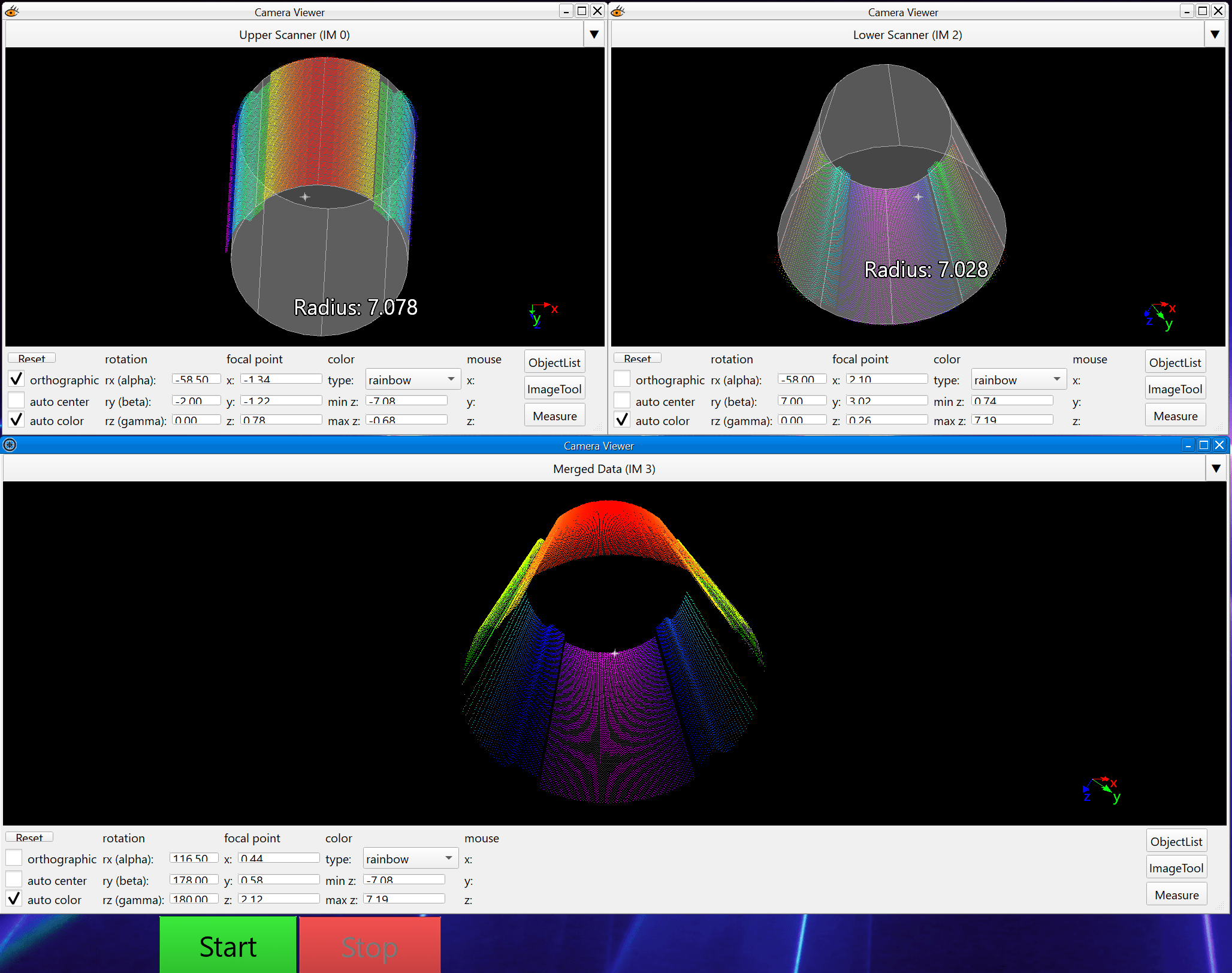
Radius Measurement with Two Laser Scanners

Why Raw Data Alone Does Not Provide Decision-Relevant Value

Modern 2D and 3D measurement systems generate large volumes of data—for example image data or point clouds. Initially, these raw data sets contain only geometric or optical information. Only through targeted feature extraction and process-oriented interpretation do they become decision-relevant information.

Process-relevant features may include:

• Geometric parameters (distances, heights, widths, gap dimensions)
• Form and position deviations
• Surface parameters
• Statistical trend values over time

The key requirement is that these features have a direct correlation with the functional or quality requirements of the component.

Transformation from Data to Information

  1. Definition of the quality decision (What needs to be evaluated?).
  2. Preprocessing of raw data (filtering, referencing, normalization).
  3. Structured feature extraction.
  4. Evaluation using thresholds, statistical methods, or data-driven models.
  5. Integration of the results into the process control system.

Systemic Approach in the Production Environment

Data quality does not become evident in the laboratory, but under real operating conditions—including cycle time constraints, temperature variation, and mechanical influences. An inline system must therefore not only measure precisely, but also convert the acquired data into stable and reproducible process information.

QuellTech follows a structured project process (“Precision step by step”), in which measurement requirements, feature definition, and serial production integration are systematically aligned. The goal is not to generate the maximum amount of data, but to provide valid, process-relevant information for industrial quality decisions.

Further information

Inline measurement solutions:
Optical Inline Measurement Technology

Project process – Precision step by step:
The QuellTech Process: Precision Step by Step

Do you have a specific Measurement Task?

We are happy to help you with that!

Stefan Ringwald

Technical Contact

Can we help you with Optical Inline Measurement?

If you have any questions about Optical Inline Measurement or would like a consultation from QuellTech on this subject, we will be happy to help.

We would like to help you to precisely evaluate your specific measurement task. Through an initial free test measurement of your application, we can give you an early assessment of the feasibility.

There is always potential for improvement, we will help you with that. Contact us for more information or to make an appointment for a consultation.

Contact us!

Would you like to assess the feasibility of your measurement task as early as possible? Contact us and take advantage of our free initial sample measurement.

By submitting the contact form, you agree that your data will be used to process your request (further information and instructions on withdrawal can be found in the privacy policy).

Technical Contact

Your technically competent contact, Stefan Ringwald, will be happy to help you.

Understanding your Challenge

Our aim is to fully understand your specific technical requirements for your current measurement task.

Well-founded Solution Proposal

Thanks to many years of experience with complex tasks in the field of 3D laser measurement, you will receive well-founded solution proposals from us.

Investitionsbooster

Hinweis für Deutsche Unternehmen:

Für Investitionen in Ausrüstungen gilt seit Juli 2025 eine degressive Sonderabschreibung von bis zu 30% p.a. – befristet bis Ende 2027.

Je früher die Anschaffung erfolgt, desto länger kann dieser Vorteil genutzt werden. 

> Jetzt informieren!

(Dies ist keine Steuerberatung, bitte wenden Sie sich für Details an Ihre Steuerberatung.)